
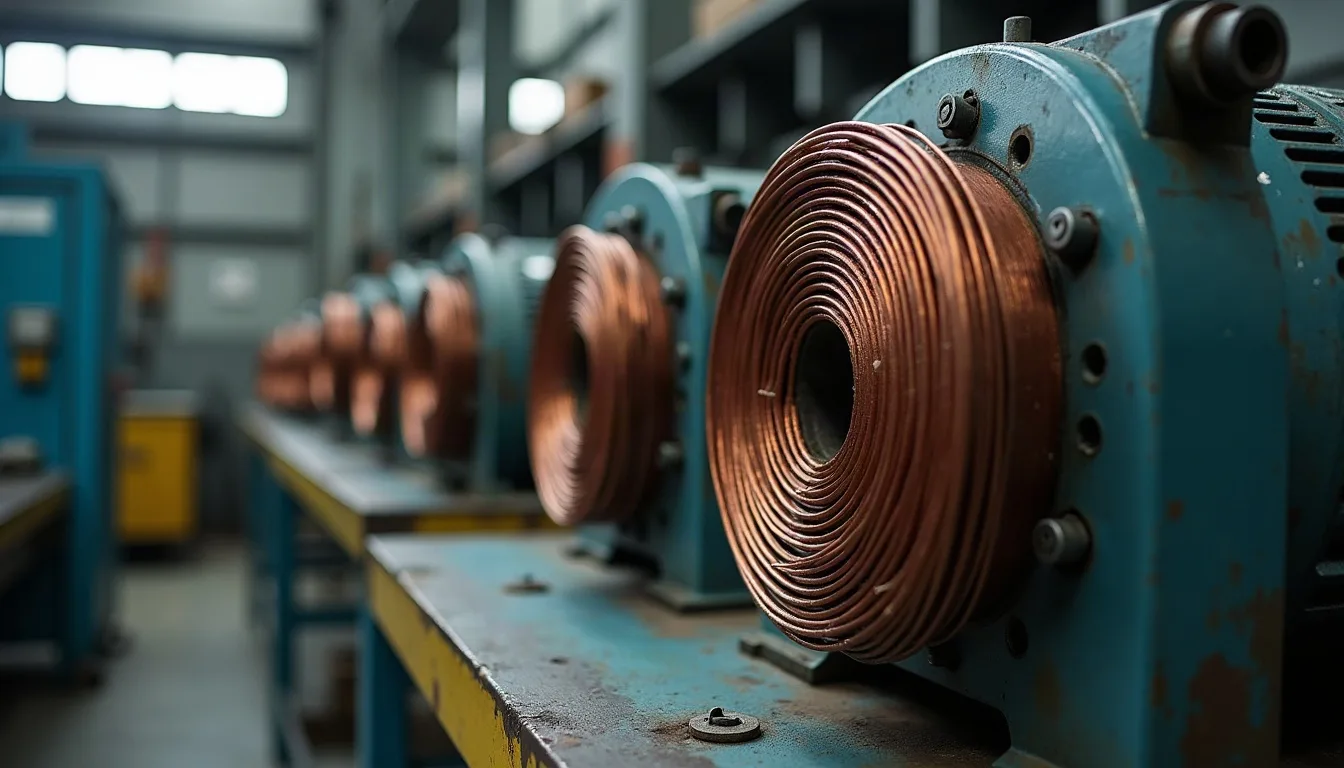
To clean an electric motor, isolate and lock out the power, remove loose dust, apply a solvent cleaner made for electrical equipment that evaporates without leaving residue, let it dry completely and check the insulation resistance of the windings before the motor goes back into service.
For motors, generators and switchgear, Eurochem S.A. supplies the LECTROKLEEN electric motor cleaner range. Ask us which one suits your equipment.
Ask about your motorWhy cleaning the windings matters
Oil, dust and salts that settle on a winding can conduct electricity and lower its insulation resistance. Cleaning and drying the winding usually brings the insulation resistance back up.
Before you start
- Switch off the motor and isolate it with lockout and tagout, so that it cannot start or release energy while you work on it.
- Check on the Technical Data Sheet that the cleaner is made for electrical equipment and suits the materials in your motor.
- Work in a well-ventilated area and follow the Safety Data Sheet of the product.
Step by step: cleaning a motor in place
- Isolate and lock out the power supply of the motor.
- Remove loose dust and dirt from the housing, the cooling fins and the ventilation openings.
- Apply the cleaner to the windings and the dirty parts. LECTROKLEEN-Q is made for the in-place cleaning of electric motors and needs no wiping.
- Let the solvent evaporate completely, so that the surfaces are left clean and dry.
- Measure the insulation resistance of the windings. Low values need further investigation before the motor is put back into service.
Which LECTROKLEEN cleaner to choose
| Product | What it is | Typical use |
|---|---|---|
| LECTROKLEEN-Q | Non-flammable, quick-evaporating solvent that needs no wiping and leaves no residue | In-place cleaning of electric motors, generators, switchgear and coils |
| LECTROKLEEN-D4 FAST | Non-flammable, quick-drying solvent with dielectric strength over 20,000 volts | Electric motors, generators, switchgear and coils, and vapor degreasing |
| LECTROKLEEN-S | High flash point and a lower evaporation rate, lasts at least twice as long as ordinary solvent cleaners | Motors, generators, panel boards, pumps and cables, ideal in warm climates |
| LECTROKLEEN ODORLESS | Completely odorless, with controlled evaporation and a high flash point | Electric motors and parts |
| 2003 LECTRO CONTACT CLEANER | Evaporates very fast, practically odorless, without chlorinated solvents | Electric apparatus, generators, cables, switches and machinery |
| 203 LECTRO CONTACT CLEANER | Leaves no residue, has a high dielectric constant and is safe on plastics and rubber | Electronic components, circuit boards and contacts |
Frequently asked questions
What can I clean an electric motor with?
With a solvent cleaner made for electrical equipment, which dissolves oil and grease, evaporates completely and leaves no residue. For in-place cleaning of motors, LECTROKLEEN-Q needs no wiping and leaves the surfaces clean and dry.
How do you clean motor windings?
Isolate the power, apply a quick-evaporating electrical cleaner to the windings, let it dry completely and then measure the insulation resistance. Low readings need further investigation before the motor goes back into service.
What is a good cleaner for electrical contacts?
A cleaner that leaves no residue and is safe on plastics and rubber. 203 LECTRO CONTACT CLEANER is made for electrical and electronic equipment and has a high dielectric constant.
Technical data for every product
Every Eurochem product page includes the Technical Data Sheet, and the Safety Data Sheet is available on request. Send us your question with the form below.
Ask about your motor
Sources
- Occupational Safety and Health Administration, Control of Hazardous Energy (Lockout/Tagout). https://www.osha.gov/control-hazardous-energy
- Control Engineering, Six tips for testing motor insulation systems. https://www.controleng.com/articles/six-tips-for-testing-motor-insulation-systems/